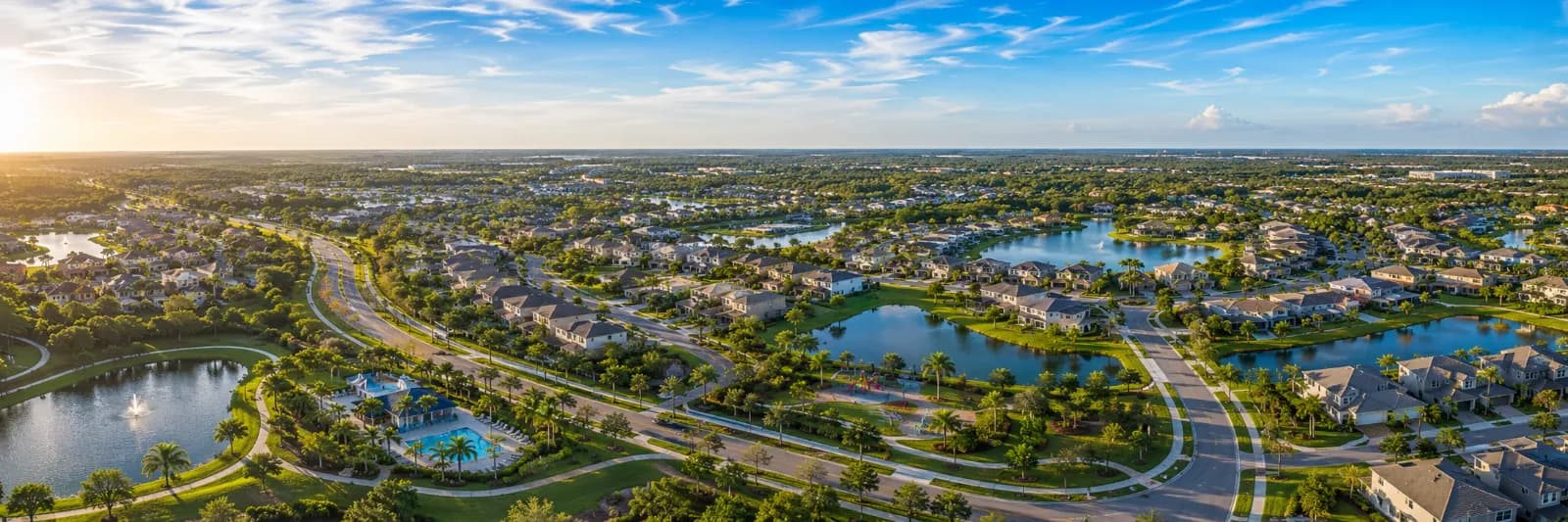


Sinkhole Guide for Florida
Florida has more sinkholes than any other state in the nation, according to the local agency that oversees insurance regulations and...

Florida has more sinkholes than any other state in the nation, according to the local agency that oversees insurance regulations and compliance.
Why so many sinkholes?
The bulk of Florida’s peninsula is made up carbonate rock (limestone and dolostone) overlain by variable thicknesses and mixtures of sand and clay (i.e., overburden). Carbonate rocks store and transmit groundwater. Through a slow chemical process these carbonate rocks may dissolve, resulting in karst terrain (topography). Karst terrains are characterized by sinkholes, caves (wet and dry), springs, disappearing/reappearing streams, and other land surface depressions all of which are commonly found throughout Florida.

Both natural phenomena and human activity can trigger sinkholes. Heavy rainfall, especially after a drought, and tropical storms contribute to the forming of a sinkhole, while man-made sinkholes can be prompted by heavy pumping of groundwater for agricultural protection, investigative drilling, and excavation.
Is there a safe place?
As far as picking a safe non-sinkhole region, where there is no chance of getting your house sucked in—there are no guarantees. Wesley Chapel and the Pasco County area have varying ranges of danger. From the Florida Geological Survey:
Since the entire state is underlain by carbonate rocks, sinkholes could theoretically form anywhere. However, there are definite regions where sinkhole risk is considerably higher. In general, areas of the state where limestone is close to surface, or areas with deeper limestone but with a conducive configuration of water table elevation, stratigraphy, and aquifer characteristics have increased sinkhole activity.

Warning Signs
Trees or fence posts that tilt or fall
Foundations that slant
New small ponds that appear after rain
Cracks in the ground
Sudden drainage of a pond
Rapid appearance of a hole in the ground
Dips, depressions, slopes that appear in a yard
Dead patches of grass or plants
Sinkholes in the neighborhood
Wilted vegetation in a limited area
Well water that is discolored or contaminated with debris
Cracking or buckling of home’s concrete slab
Presence of odd bugs like slugs and centipedes in the home
Earthy odor in home after rain
New or widening cracks
Separation between walls and ceiling or floors
Cracks in interior walls
Cracks around door and window frames
Cracked grout between tiles
Cracked tiles
Stairstep cracks in blocks or bricks
Insurance Facts
In Florida, insurance companies are required to provide homeowners insurance coverage that includes damage from “catastrophic ground cover collapse.” They are also required to offer sinkhole damage coverage as an option, and it generally appears in a rider that comes at an additional cost. The insurance law defines catastrophic ground cover collapse in a different way than it defines a sinkhole.
Catastrophic Ground Cover Collapse
By Florida law, four conditions must be met for Florida homeowner’s insurance to cover damage (building and contents) from catastrophic ground cover collapse:
The sinking of the top layer of soil must occur abruptly. A depression in the ground cover must be clearly visible without the aid of instruments. There must be structural damage to the home, including the foundation itself. A government agency must condemn and evacuate the structure.
Settling or cracking of a structure does not automatically trigger coverage for catastrophic ground cover collapse.
Damage from a sinkhole that meets all the above conditions should be included in coverage for a catastrophic ground cover collapse. Damage from a sinkhole that does not meet the above conditions will not be covered, unless sinkhole coverage has been purchased separately.
– http://www.earthtech.com/





What do you think?
Share your perspective with your neighbors.
Free to join. Your draft stays here while you sign in.
Be the first to share your thoughts.